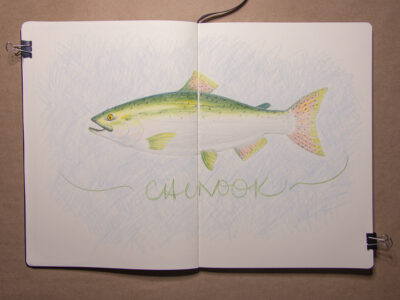
In 2022, salmon went to court for the very first time. They of course didn’t actually go to court; representatives of the Sauk-Suiattle Indian Tribe went on their behalf.
The Sauk-Suiattle sued the City of Seattle in tribal court claiming the City’s hydroelectric dams violated the rights of salmon and tribal members. The City built the dams without providing a means of fish passage, or a way for spawning salmon to move around the dams.
The Tribe sought a ruling that salmon have inherent rights to “exist, flourish, regenerate . . . and restoration,” and that the Tribe has the duty to “protect and save” salmon from harm and decline. What they got was an agreement from the City to establish a fish passage program around the dams.
This isn’t the ruling the Tribe asked for, but it is the practical outcome they wanted. And according to Jack Fiander, Tribal Attorney for the Sauk-Suiattle, it’s good news for rights of nature:
“Resolving [the lawsuit] in such a way that the tribe was able to protect the salmon, even if it’s through a settlement or by agreement . . . makes future cases involving truly advocating for rights of nature easier to present,” Fiander said. – “Suing for Survival”
Tribes are the main movers of rights of nature in the U.S. right now, so it was interesting to hear the tribal attorney, Jack Fiander, speak about the case. The webinar I watched was recorded in March 2022, before the case was resolved.
First Rights of Salmon Case Goes to Tribal Court
These are a few of the points that stood out for me:
How the tribe decided to sue the City of Seattle (min 14:40):
The tribal council decided to consider themselves an equal party with other governments that have a say in salmon perpetuation and regulation.
The tribal council also decided that their Creator’s law was just as valid as the Christian Creator’s law. When Europeans set out to “discover” new lands, the Pope declared the Christian Creator’s law as authority for seizing lands that were already inhabited by non-Christians. The U.S. Supreme Court as recently as 2005 cited the Pope’s decree as authority for holding title to indigenous lands.
How seriously the City took the case (min 33:40 and 44:10):
The potential of rights of nature claims has been dismissed by many in the environmental community: groups, lawyers, and law professors. Yet when faced with a lawsuit, the City of Seattle, backed by industry, took the case very seriously. The City hired an international law firm and went straight to federal court to try to stop the tribal court from even hearing the case.
The “inside baseball” on how the City of Seattle is/was virtue signaling with its power utility (min 39:40):
The City’s electric utility calls itself the “nation’s greenest utility,” yet the three hydroelectric dams it operates on the Skagit River are harming fish populations. Particularly, endangered fish populations. The dams generate low cost power for the City because they don’t have the added expense of providing fish passage.
Interesting. Hope you enjoy it.
 Secret Knowledge