“The rivers are our brothers. They quench our thirst. They carry our canoes and feed our children. You must give to the rivers the kindness you would give to any brother.”
~ Chief Seattle
We’ve built an astounding 91,843 dams in this country, and that’s just the ones that are over 6-feet high. The real number is closer to 500,000. In the name of economics and expansion, we traded brotherly kindness for concrete.
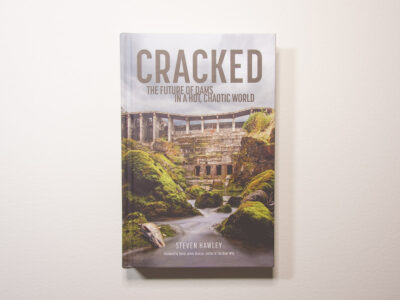
I recently read Cracked: The Future of Dams in a Hot, Chaotic World, by Steven Hawley. He provides a scathing overview of the history of dam building in the US, and the governmental greed and corruption that fed it. Over the last century or so, we dammed up this whole country and spread our dam ideology all over the world.
“Really big dams, and the proliferation of millions of smaller ones . . . are an American invention. The American gospel of dams was spreading to major watersheds worldwide as early as the 1950s. Those busy beavers at the United States Army Corps of Engineers were already globetrotting back then, promoting the virtues of megatons of concrete as a panacea for ills economic, agricultural, industrial, and hydrological. Their sales pitch, at home and abroad, was less than forthcoming about the inevitable risks and the colossal damage that would ensue.”
~ Steven Hawley, Cracked
Greed and corruption aside, we built dams for seemingly good purposes — water storage, irrigation, flood control, power generation — but we failed to take the river’s needs into account. Dams and the reservoirs behind them destroy river ecosystems. They change the water temperature, reduce the water quality, degrade the habitat for aquatic creatures and surrounding wildlife, prevent fish from being able to migrate, erode shorelines, drown beautiful stretches of river, and more. Rapidly disappearing wild fish populations around the world are a sure sign the dam era needs to end.
Here are a few notable points from the book:
Dams are not clean or green.
Hydroelectric dams have long been touted as clean, renewable sources of energy production. They don’t burn fossil fuels, which is great; no carbon emissions. But studies now tell us this isn’t the full story:
Dams worldwide emit about a billion tons of greenhouse gases per year.
Reservoirs behind dams emit methane. Compared to carbon dioxide, methane leaves the atmosphere more quickly but traps at least 28 times more heat while it’s there.
Methane is produced when vegetation trapped at the bottom of reservoirs decomposes. Over time, it rises to the water surface and then out into the atmosphere. In addition to this natural release, reservoirs help methane escape when: water passes through the dam, power generating turbines spin, and water levels are raised and lowered.
In 2022, the US EPA started including reservoir methane emissions in its annual climate report to the UN.
Reservoirs worldwide lose more water to evaporation than municipal and industrial use.
These losses are particularly bad in arid environments, like Egypt, India, and as the author discusses in detail, the Colorado River Basin.
The arid American Southwest has been in a state of drought since 2000. While water managers struggle to divvy up the Colorado River’s dwindling flows to the seven states it serves, evaporation is taking a big cut. Dam-created reservoirs, especially the major ones, Reservoirs Powell and Mead, are losing 10 or possibly even 20% of the river’s flow to evaporation every year.
Big dam building continues; a free river movement is happening, too.
The author writes about ongoing, so far successful, efforts to fight dam proposals in places like Patagonia and the Balkans where rivers still run free. Dams are also coming out all over the world — Australia, South Africa, Japan, and across Europe.
According to American Rivers, the US successfully removed 80 dams across 25 states in 2023. In total, we’ve removed just over 2,000 dams in the last century.
The good news is that the old dams are starting to crumble. Many of them are in need of expensive safety repairs or upgrades, and the costs will outweigh their benefits. Especially since a lot of old dams no longer serve any purpose. People once built dams to power mills or small factories that no longer operate; or to create fishing and swimming holes. Some dams are so old nobody remembers what they were for.
I’ve heard people argue that we need dams, because we need power. But according to the US National Inventory of Dams, only 3% of dams are hydroelectric. One-third of our dams are categorized as recreational.
If there is talk of dam removal in your area, and you’re wondering if it’s a good idea, my answer is this:
~ Let the rivers run free. ~
It’s time for us to be kind to our brothers (sisters?).
For more about dam issues:
Cracked: The Future of Dams in a Hot, Chaotic World
DamNation: The Problem with Hydropower
“Free Rivers: The State of Dam Removal in the United States”
 How You Can Help Bees and Butterflies