
The Great Mother and the Fall
This is part of the series From Ego to Soul: Remembering the Right Brain’s Wisdom. [Read Part 1] [Read Part 2] [Read Part 4] [Read Part 5]
If you’re born into a system, and so are those who raise you and live around you, it’s very difficult to recognize the system—until someone finds all the research on the time before the system existed, and then writes a book.
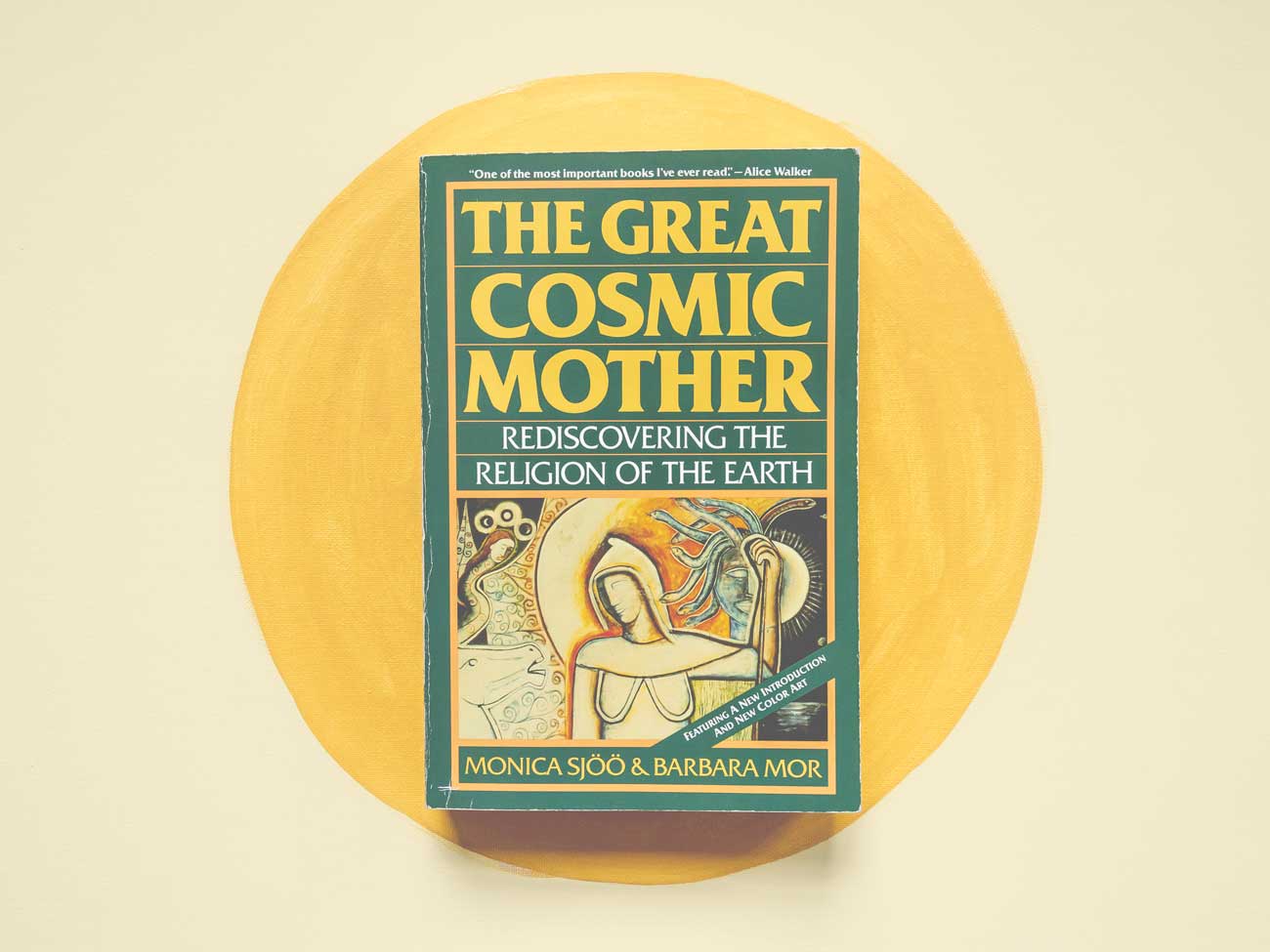
In The Great Cosmic Mother, Rediscovering the Religion of the Earth, authors Monica Shoo and Barbara Mor detail research from the Paleolithic period of human civilization to present day. They explain the fall of matrilineal societies to the rise of what has become our current patriarchal society.
This book is intense, and the tone reflects the weight of what it’s documenting. I almost put it down a few times, but I kept going because it was so fascinating. In the end, it completely shifted my world view.
Patriarchy, it turns out, isn’t just about women’s rights—it goes far deeper than that.
For 30,000 years of documented human existence on this planet, women and men lived a deeply embodied connection with the Great Mother, the Goddess, the living essence of the Earth and the entire cosmos. Archaeological evidence shows they lived in matriarchal communities all over Europe, Africa, and North America.
These societies weren’t built around hierarchy and dominance, but rather the fact of the primary role of the mother. They were essentially non-aggressive, peaceful, women-led societies that lived in physical and spiritual harmony with the Earth and her seasonal and lunar cycles.
The women, the authors argue, were the originators of civilization. They were the ones who developed crafts like pottery, weaving, textile dyeing, and leather tanning. They were the ones who first gathered and studied medicinal plants, made lunar calendars, developed agriculture, and led spiritual ceremonies. They raised children, built homes, kept bees, made art, and stored grain.
The men supported the women’s matriarchal center. They were responsible for hunting and protection. But they also nurtured children, participated in spiritual ceremonies, and worked with the women on craft and building projects. In some communities, the men managed the outer world of trade while the women managed the inner world of family and community.
And through it all, they knew that the Earth is alive. Not metaphorically alive, but actually—what the authors call “a great animal inhabited by a life-spirit.” They saw themselves, and all other life forms as “protoplasmically connected with each other as in the same body, the same imagination.”
This was the Goddess they worshipped—not an abstract deity, but the living, breathing Earth herself. The Great Mother wasn’t separate from nature; she was nature, the creative force that births and sustains all of life. And to them, this sacred Earth spirit was the primary creator of all planetary manifestations.
But then everything changed—4,000 years ago, a multi-faceted cultural shift led to the violent takeover of the patriarchy.
Several developments converged: women’s grain storage techniques made agriculture more reliable, reducing communal dependence on hunting. Metal-making, which had been a sacred art, transitioned into producing tools and then weapons. These shifts fundamentally altered men’s roles in society.
And then nomadic tribes from Eurasia began migrating south and west. They brought with them a very different social structure: aggressive, male-dominated, hierarchical, and centered around warfare. Their gods were warriors and sky-based deities.
Over time, men replaced hunting with warfare, took charge of women’s industries, and asserted paternal control. Agricultural villages turned into walled cities, time became linear, and women lost their honored societal status—their value became tied to producing heirs for the father’s line. And the Earth lost her revered status and began to be seen as nothing more than a material object for man’s use.
Women and men alike lost their direct, felt connection to the Great Mother, and she was replaced with the mental concept of, in the authors’ words, an “abstract and alienated, distant and moralistic” male in the sky.
Patriarchy isn’t just about gender equality—it’s about the suppression of an entire way of knowing and being. It’s the left brain stamping out right brain values on a civilizational scale.
The authors make the striking claim that “this disconnection is patriarchy.” Separating us from the right brain’s feminine worldview isn’t a byproduct, it’s the whole point.
Patriarchal structures profit from keeping us alienated from what the authors call “the experience of cosmic oneness.” This is how the left brain maintains control. We’re not just taught to dismiss the right brain—our entire infrastructure is designed to distract us from it.
The freeways, the shopping malls, the 24/7 news cycle, the dopamine hits from social media. These systems are designed to keep us moving, consuming, anxious—anything to prevent us from being still enough to hear the silence where the right brain speaks.
The authors describe whole industries built on “selling momentary diversions” to people seeking “anesthetic escape from the pain of personal alienation.”
War itself is a tool of patriarchal control. If we’re not at war, we’re preparing for it, or talking about it. It’s a constant threat that keeps us fearful and reactive, and it diverts much-needed resources from art, education, feeding people—the right brain’s “soft” concerns.
The patriarchy profits from keeping us disconnected from our souls.
Today, this patriarchal worldview seems like normal modern life. When you’ve always lived within a system, it’s hard to see it for what it really is. But now we can see it:
We understand the brain framework. We know the proper hierarchy—that the right brain is meant to lead. And we can see the historical sweep: 4,000 years of left brain, ego domination, of thinking we’re just insignificant material objects on a rock floating through space.
The magnitude of this is staggering. But recognizing it is the first step toward recovering what we lost.
We always assume ancient people were less developed, that we’re at the height of civilization. But the left brain loves to call whatever it doesn’t understand “primitive.” Those early humans lived in spiritual oneness with the universe, the Earth, and all living beings—for 30,000 years.
That’s not primitive. That’s mastery we’ve forgotten.
But, how could so many thousands of years of human soul connection have been overturned so completely? Did the right brain give up that easily, or did something else happen?
Continue the series: Where Did the Goddess Go?