
The Road to Good Drawings
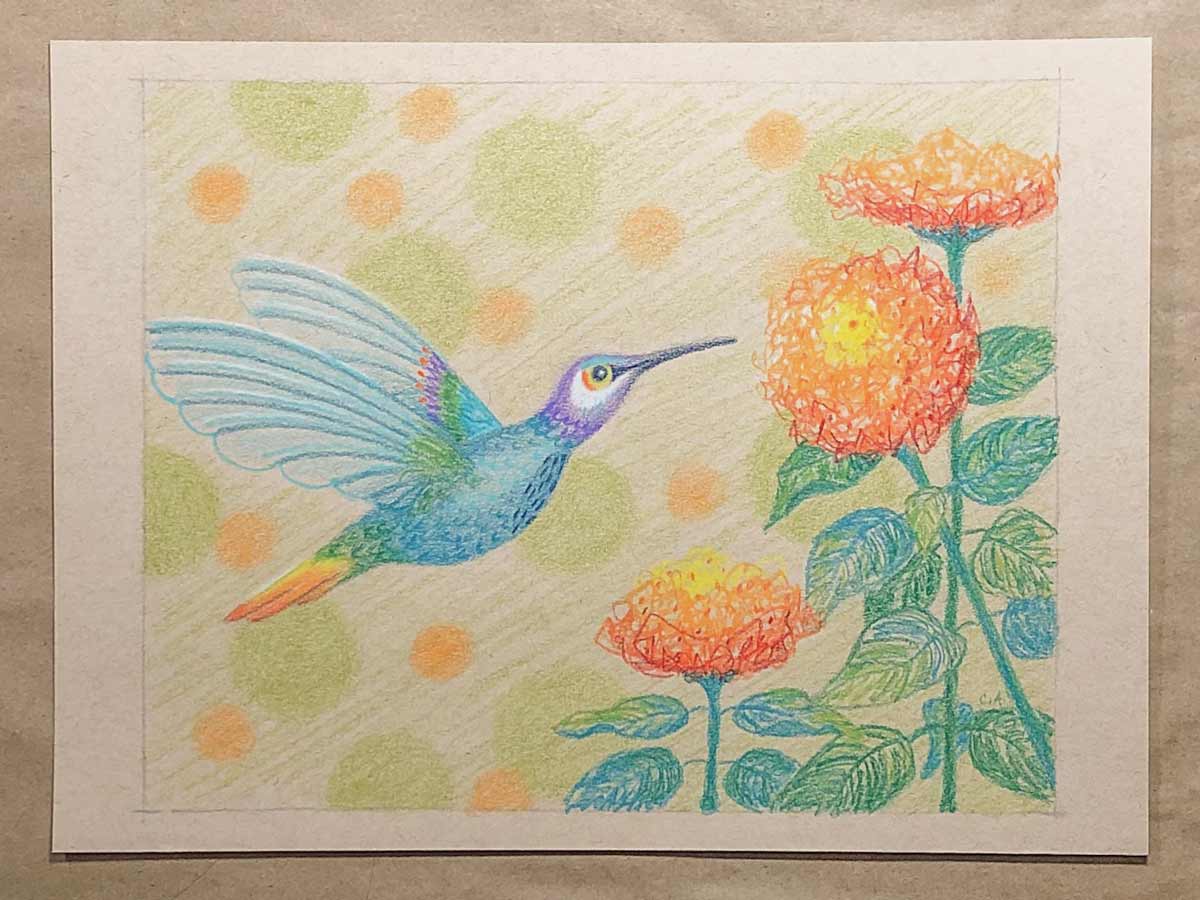
“I could never draw something like that.” My niece was seven.
When I first started taking my artwork seriously, my sister asked me to make an animal drawing for her birthday. She had seen a zebra drawing of mine and wanted something similar for herself. I decided on a hummingbird. She gave me her favorite colors, and off I went to begin the new project.
But as I sketched out my idea, I realized my vision for this drawing was more complex than anything I had done before.
My first versions were not good.
In fact, they made me want to give up right at the start, but I had already given up on my art too many times in the past. That was not going to be an option this time. This hummingbird would be the best drawing I could make, and that would be enough. Somehow, I told myself, it would all come together for my sister’s birthday.
Along the way, every time doubt said, you can’t, I answered back: I can. And kept working.
To help with the complexity of my initial vision, I decided to separate the drawing into manageable pieces—hummingbird, flowers, background—and master each one separately. I picked colors, chose positioning, and practiced shading and line work. Once each part worked, I put them all together in a full drawing.
The day before my sister’s birthday, I completed the final version, and I was so pleased with the way it turned out. I didn’t know what she would think, but I was proud of what I had created.
It wasn’t just about the drawing at that point, it was about the effort. I had pushed beyond my mentally created boundaries and now knew that I could continue making more and more complex work.
The hummingbird drawing was beautiful, and I loved it—and it was only the beginning.
When I arrived at my sister’s house to deliver her gift, my niece excitedly asked, “Can I see it?!” She’s a budding artist herself and had been eagerly anticipating the finished drawing. As I opened the package to give her a sneak peek, she gasped and told me it was beautiful.
I sighed with relief. If my niece approved, my sister would too. Sure enough, my sister loved the hummingbird, and they graciously spent a satisfyingly long time oohing and aahing over all the details. I savored the happy moment, and started feeling excited for all the drawings I had yet to create.
But then my niece said something that made me pause. She studied the drawing one more time, and something shifted in her expression. She looked down. “I could never draw something like that.” She was seven years old.
Only a few weeks earlier, I told her, I wasn’t sure I could draw like that either. I explained my process and filled her in on the often ignored secret that good drawings are the result of a lot of bad ones. Did she take that in? I’m not sure. She said something similar to me the following year, and again I reminded her: the road to good drawings is paved with bad ones.
I’ll keep reminding her, because if she wants to, she can surely make her own version of my hummingbird drawing someday—she’s still in elementary school.
It does make me wonder though about our tendency to talk ourselves out of our own capabilities. How early does it start? My niece was well versed in “I could never” by age seven. Her mind narrowing the path ahead when she had only barely begun the journey.
How many of our perceived limitations are just elementary school fears disguised as incapability?
How many times have we told ourselves I could never when the truth was simply, I haven’t yet?